
More and more companies are discovering that simply changing passwords or purchasing a basic router from their provider isn't enough to truly protect data and employees. Attacks today are fast, automated, and often invisible at first glance—and a single misclick can bring an entire company to a halt for an hour, a day, or sometimes longer.
That's why companies that take cybersecurity seriously are turning to business-class solutions like Fortigate. This isn't just another "Wi-Fi router," but an advanced firewall that acts as an intelligent gatekeeper at the entrance to your network. It analyzes traffic, blocks threats, and ensures that employees can operate safely—both in the office and remotely.
In this article, we'll explain in simple terms how Fortigate works, why its capabilities extend far beyond standard hardware, and when it's truly worth implementing in a small or medium-sized business. You'll learn about its key features, use cases, and a practical implementation process—all without marketing jargon or comparisons to other vendors. Just reliable knowledge based on official sources and experience working with companies that prioritize better security.
Want to understand why Fortigate is considered one of the most effective solutions for protecting business networks? Let's get started.
Fortigate in the company – what exactly is it and why do you need a firewall?
Many companies treat a router as their network's only security measure. This is natural – once the device is operational and provides internet access, it seems to be taken care of. The problem begins when the first hacking attempts occur, unwanted external connections, or an employee accidentally clicks on a suspicious link. A home router wasn't designed to deal with such threats. It merely "hands out the internet," and nothing more.
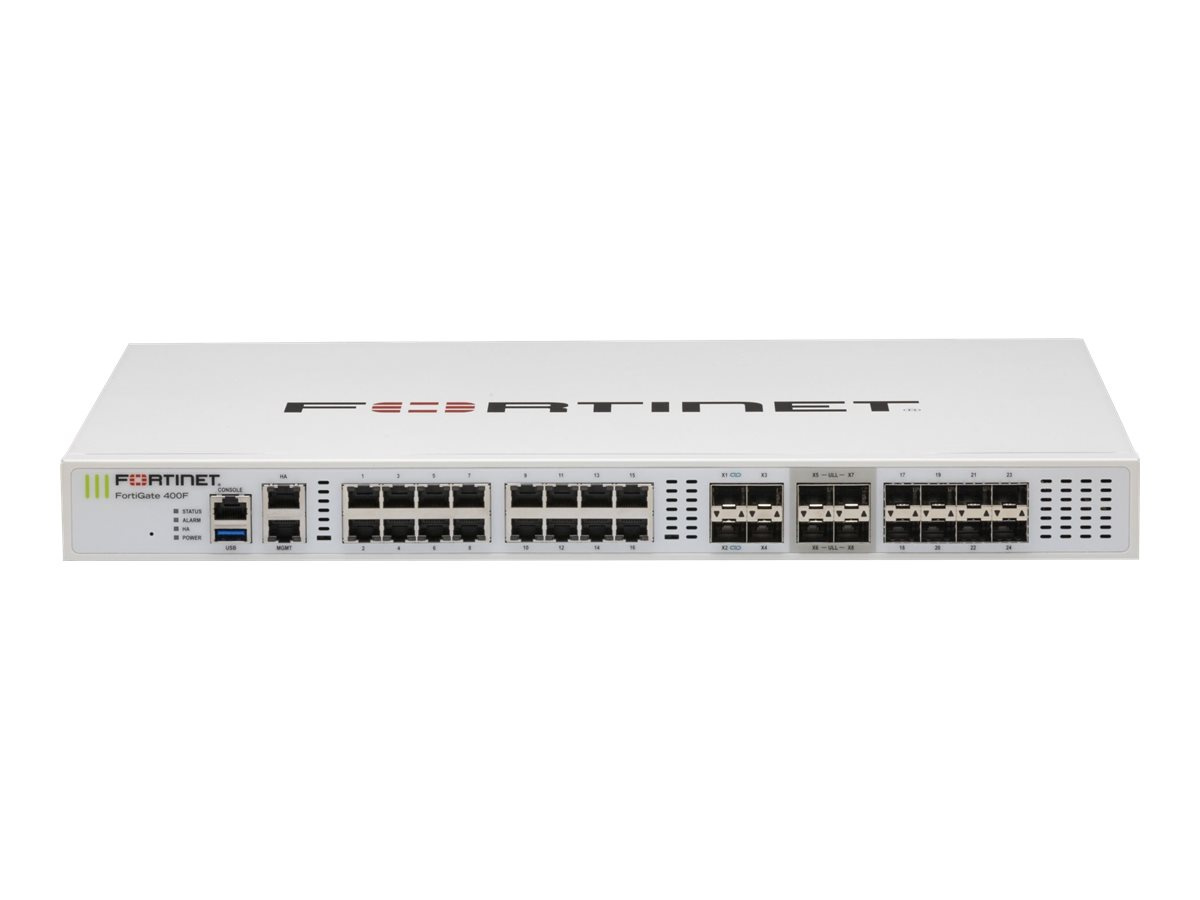
Fortigate It works completely differently. It's a next-generation firewall that sits at the edge of your network and inspects every traffic—incoming and outgoing. By design, it doesn't trust anyone until it's sure the connection is secure. It's like an intelligent security system that not only guards the door but also monitors who's trying to enter, why, and whether their behavior looks suspicious.
Importantly, Fortigate isn't a product for "large corporations with their own IT departments." It's a solution that truly helps small and medium-sized businesses where data security is paramount, but owners prefer to avoid complex tools, additional administrators, or the daily management of firewall settings. Its strength lies in its combination of advanced technology with ease of use and operational stability.
Why do you need a firewall at all, and not just antivirus? Because antivirus protects a single computer, and threats primarily enter through the network—before reaching employee devices. Fortigate stops them at the gate. This allows:
• you reduce the risk of infections and attacks,
• you protect all devices on the network, not just those with antivirus,
• you control who has access to what,
• you protect company data and communications, including remote ones.
In practice, Fortigate becomes the foundation of a secure infrastructure—something that runs in the background but protects your workday. If your company stores sensitive data, works remotely, uses a file server, or simply can't afford downtime, a firewall isn't a luxury. It's a necessity. Fortigate is one of the most reliable tools that truly meets these needs.
How Fortigate Protects Your Corporate Network? Key Features in Plain Language
Many business owners hear Fortigate as an "advanced next-generation firewall," but it's difficult to understand what that actually means in practice. So, let's walk through the key features in a straightforward and business-friendly way—without technical acronyms or jargon.
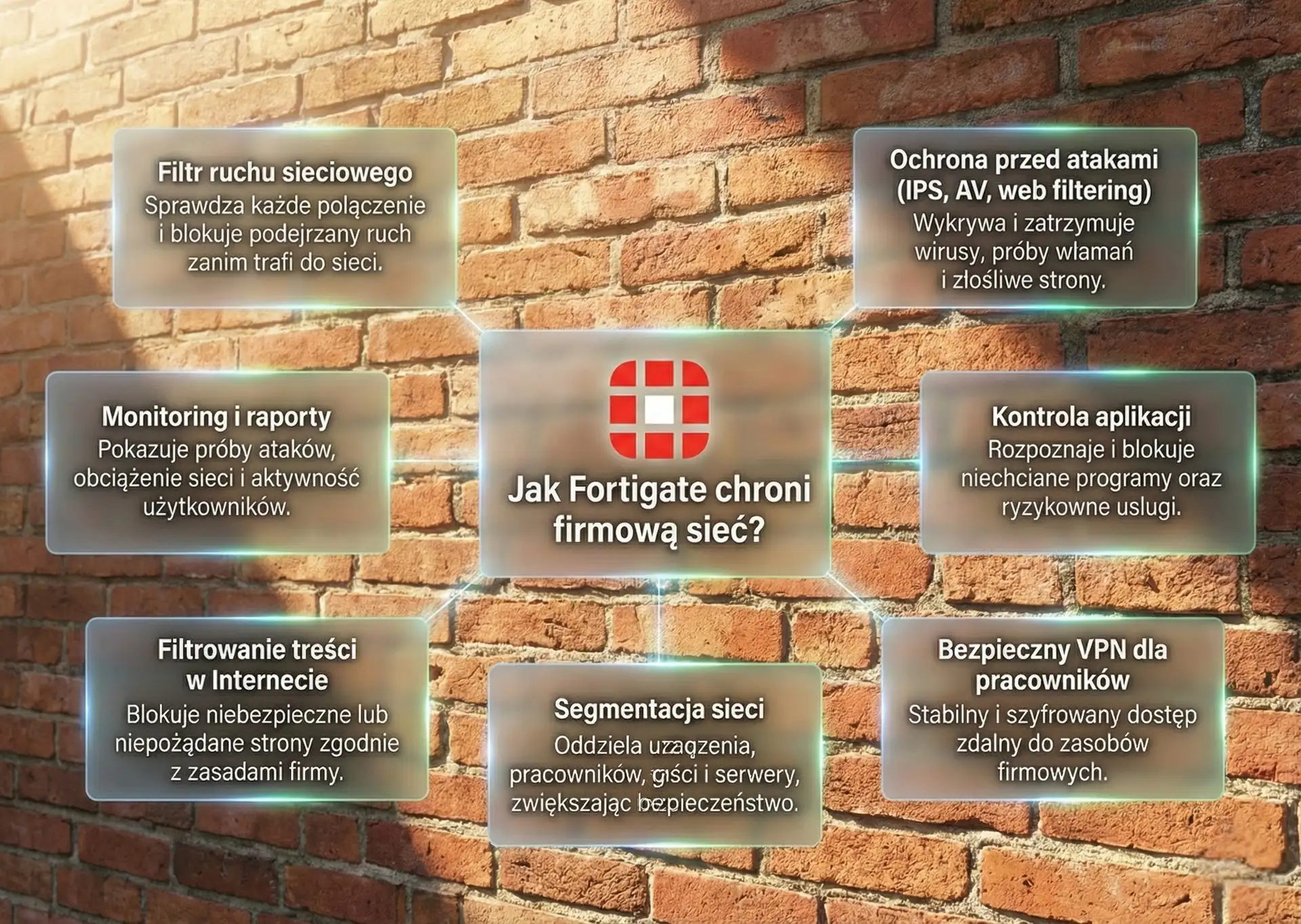
Network traffic filter – who and what can access your network
A home router lets almost everything in. Fortigate does the opposite: it inspects every packet of information before letting it in. This blocks:
• attempted burglaries,
• traffic from suspicious sources,
• communication typical of malware.
This can be compared to a security guard who not only checks the ID of visitors, but also their intentions.
Protection against Internet attacks (IPS, antivirus, web filtering)
Fortigate doesn't wait for threats to reach your computer. It stops them at the network edge. The device can:
• detect known forms of attacks,
• block malicious files,
• cut off access to dangerous websites before an employee can click on them.
It works in layers, so even if one mechanism lets something through, another has a chance to intercept it.
Application Control – Blocking what shouldn't run in your company
Applications that the owner is unaware of can run on a company network: games, instant messaging, P2P programs, and unauthorized file-sharing tools. Fortigate can recognize and manage these applications appropriately:
• allow,
• restrict,
• block completely.
This is especially important when you care about security and optimal use of the connection.
Secure Remote Access (VPN)
Remote work is standard in today's companies. The problem is that many VPN solutions are either inconvenient or unsafe. Fortigate offers stable, easy-to-use, and secure access to company resources, allowing employees to:
• connect from home, on a business trip or abroad,
• work as if they were in the office,
• do it without the risk of someone unauthorized "intercepting" the traffic.
Network Segmentation – Separating What Shouldn't Be Mixed
In many companies, all devices are on one network: printers, guests, employees, cameras, servers.
This is a big risk because if something happens in one place, it can spread throughout the entire company.
Fortigate allows you to divide your network into logical „zones”, e.g.:
• employee network,
• guest network,
• network of devices,
• server network.
Each of them has its own security rules, which significantly increases the level of protection.
Intelligent content filtering and internet access control
Whether you want to protect your employees from dangerous websites, minimize the risk of phishing, or limit time spent on non-work-related websites, Fortigate gives you precise control tools.
You can:
• block entire categories of websites (e.g. gambling, malware, suspicious websites),
• allow exceptions,
• create rules for specific departments, teams or devices.
Monitoring and reporting – full transparency of what is happening online
Fortigate collects detailed network traffic and threat information so you can see:
• where the attempted attacks come from,
• what websites are blocked,
• which devices generate the most traffic,
• whether the VPN is working properly.
This is not a curiosity – it is a real help in making decisions and quickly diagnosing problems.
To sum up: Fortigate is not a single tool, but security kit, that protect your network on multiple levels simultaneously. This helps you reduce risks, secure all your devices, and build a stable work environment that operates reliably every day.
Why Fortigate and not a "regular router"? The difference you'll see in practice
At first glance, a router and Fortigate do the same thing—they provide the internet. In practice, however, the difference between them is like between a calculator and a full-fledged accounting system. Both calculate, but only one captures the total.
Regular router It was designed for home use: a few devices, simple traffic, and minimal protection. It doesn't analyze threats, filter content, or control applications, and it's not designed for attacks or intense corporate workloads. If anything unusual happens, it will freeze or simply allow traffic it shouldn't.
Fortigate It's business-class hardware: a firewall, traffic analysis system, content filter, attack protection, and a secure VPN—all in one device. Its purpose isn't just to "work," but to ensure nothing unwanted happens on your network.
In everyday work the difference is very specific:
• the network is more stable and can withstand greater load,
• employees have secure remote access,
• hacking attempts are blocked automatically,
• suspicious pages do not open at all,
• you know exactly what's happening online and why.
That's why Fortigate is chosen by companies that want to ensure their networks are protected on multiple levels, not just "somewhat secure." If the internet and data are critical to your business, the difference between a router and a Fortigate-class firewall quickly becomes noticeable—both in security and in your team's daily work.
Key Fortigate features that really help your business
Fortigate isn't "just another network device," but a security hub that works behind the scenes and solves many real-world business problems. Instead of focusing on the technical details, we've summarized the most important features below that will significantly improve your team's daily work and security.
• Secure remote access (VPN)
Employees connect to company resources from anywhere, without sacrificing security or stability.• Separation of guest networks from the corporate network
Guests or subcontractors do not have access to employee servers, printers or files.• Protection of servers and devices in the office
Fortigate filters traffic before it reaches NAS, cameras, accounting systems, and business applications.• Control access to websites and applications
You can block risky websites, restrict access to specific sections, or filter content categories.• Precise network segmentation
Devices and departments operate in separate zones, so any problem does not spill over to the entire company.• Automatic security updates
Fortigate downloads up-to-date threat signatures, protecting your business from new types of attacks.• Stability and high performance
The network performs predictably, even as the company grows and traffic loads increase.• Reports and insight into what's happening on your network
The administrator or IT manager sees attempted attacks, bandwidth constraints, and potential problems before they become serious.
These features not only increase security but also improve the work experience. Fortigate simply smooths the operation of the entire infrastructure—from remote work, to data security, to user access management. This results in more stable business operations and significantly reduces the risk of incidents.

What does Fortigate implementation look like step by step in SMEs?
Fortigate implementation doesn't have to be complicated or burdensome for a company. The entire process can be managed so that the network remains operational without interruption, and the owner knows exactly what's happening at every stage. Below is the simplest and most common implementation process for small and medium-sized businesses.
Analysis of current infrastructure
We check what the network looks like, what systems are used and where risks may exist.Choosing the right Fortigate model and license
The device must fit the company's size, number of users, and growth plans.Preparation of an implementation plan
We determine the configuration, schedule, and installation method to avoid downtime.Basic security configuration
Creating traffic rules, network segmentation, content filtration and basic policies.Creating and testing VPN and user access
Employees receive secure, convenient remote access.Testing, optimization and training
We check the stability of operations, adjust rules, and provide the company with the most important information.
After deployment, continuous monitoring and ongoing maintenance of the firewall are also possible, ensuring Fortigate is operating optimally and ensuring your business's network remains fully protected. If you want to go through this process smoothly, we can help you plan and execute every step.
How much does Fortigate cost for a company and how do you approach the budget?
Cost Fortigate depends on two elements: the device itself and the license that enables full security features. For small and medium-sized businesses, the most frequently chosen models are those from the series 60E / 60F, because they offer good performance and a wide range of security features. In reality, this usually means an investment of several to several thousand zlotys, depending on the selected license package and time horizon (1, 3, or 5 years).
It's important to remember that the hardware itself is only part of the cost. Licenses are responsible for key security features, such as IPS, content filtering, attack protection, updates, and a stable VPN. Therefore, when planning your budget, it's worth considering the full cost of ownership—not just the hardware purchase but also the subsequent protection.
The most sensible approach is to approach the topic in three steps:
determine the actual needs of the company (number of users, remote work, servers, NAS),
choose a model that has the appropriate power reserve,
choose licenses for 1–5 years to ensure that the system is truly effective and always up to date.
SMEs are increasingly treating Fortigate not as an expense, but as an investment in business continuity and data security. The cost of a single incident can be many times higher than the cost of proper protection, which is why most companies choose solutions that are stable, vendor-supported, and scalable for years to come. If you want to optimize your budget or have doubts, we can help you choose an option that doesn't overpay for features your company doesn't need.
| Sample model/variant | What does it include? | Typical cost (net/gross)/notes |
|---|---|---|
| FortiGate 60E – basic model (hardware firewall) | Hardware only, no extended features license | approx. ~ PLN 2,900 net |
| FortiGate 60E + UTM/security licenses (e.g. firewall + IPS + filtering + support) | Firewall + network protection + security updates | 1-year package: approx. PLN 4,500 gross |
| FortiGate 60F (with security licenses) – small/medium businesses with more advanced needs | Hardware + licenses (firewall, IPS, filtering, VPN etc.) | When purchasing a set: approx. PLN 12,800 gross for the full protection package (depending on the offer) |
| FortiGate "Higher End" / for Larger Business (if traffic, users or needs grow) | More powerful hardware, higher bandwidth, security licenses | The costs increase proportionally – realistically, they amount to several thousand zlotys net plus licenses. |
Frequently Asked Questions about Fortigate
No. Models like the Fortigate 40F and 60F are designed specifically for SMBs. They provide comprehensive network protection without the complexities of administration. In many cases, they're the most sensible choice for companies that store customer data or utilize remote work.
No. Once properly implemented, the device operates stably and automatically updates its security features. Periodic specialist supervision is sufficient, and if necessary, we can take over this maintenance as part of our regular service. IT support.
Fortigate filters threats before they reach the corporate network, but it doesn't replace protection on the devices themselves. The best results are achieved by combining both layers: a firewall and antivirus on workstations.
Yes, we select a solution based on employee headcount, system type, company growth plans, and budget. This means you don't overpay for features you don't need, while still having the power to last.
We operate locally in the Masovia region, including Warsaw, Ożarów Mazowiecki, Błonie, Stare Babice, Pruszków, and the surrounding areas. We also conduct remote implementations throughout Poland. We can assist with both needs analysis and full firewall configuration.
Fortigate is a solution that truly improves security for small and medium-sized businesses. It combines advanced protection, stability, and ease of use, ensuring network reliability and significantly reducing the risk of incidents. It's an investment that translates into more peace of mind for the entire team and reduced concerns about data and remote access.
If you're wondering which Fortigate model is right for your company and how to best plan your implementation, we can guide you through the entire process and recommend the most sensible solution. We're happy to help.